
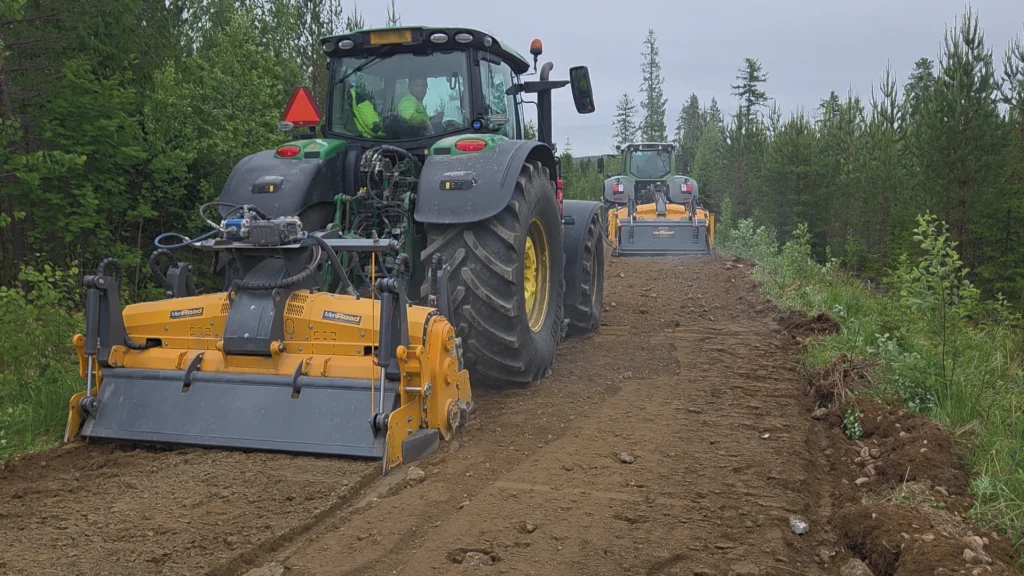
Forest Road Rehabilitation with MeriRoad Equipment – A Cost-Effective and Environmentally Friendly Process from Start to Finish
A new demonstration video shows a complete forest road rehabilitation process carried out with MeriRoad equipment. The video presents the full road maintenance operation step by step, from road edge clearing and surface crushing to grading, profiling, compaction and final finishing.
The MeriRoad method is based on onsite material recycling. Existing road material is reused directly on site, while oversized and harmful stones are crushed into a usable, gradable surface layer. This reduces the need for imported aggregate, decreases the amount of transport required and makes road rehabilitation both more cost-effective and more environmentally friendly.
When the existing material can be reused directly in the road structure, less new material needs to be brought to the site and less old material needs to be transported away. This saves time, reduces transport costs and lowers the overall environmental impact of the project. At the same time, the result is a smoother, stronger and longer-lasting road surface.
The method is especially well suited for forest road maintenance, gravel road rehabilitation and demanding road improvement projects where mobility, efficiency, cost control and durability are important.
Step-by-step road rehabilitation process
The work begins with clearing the road edges. Material can be graded onto the road before crushing or, alternatively, pushed away after crushing, depending on the condition of the road and the desired final result.
In the next phase, the road surface is crushed to the desired working depth, typically 10–20 cm. Crushing creates a large stone-free, gradable material layer on the road surface and prepares the road for accurate shaping.
After crushing, the road is graded and profiled. The grading process can be repeated one to three times until the desired road profile is achieved. Proper road profiling improves water drainage from the road surface and helps prevent damage from forming.
Proper compaction is then carried out to create a stable and durable road surface. If needed, the road can also be reprofiled after compaction. A well-compacted surface withstands use better and helps extend maintenance intervals.
The roadside areas are then cleared, and material from the road edges is spread and pushed further away from the road. Finally, the road is compacted once more to complete the rehabilitation process.
A cost-effective solution for forest road and gravel road maintenance
Road rehabilitation carried out with MeriRoad equipment helps make efficient use of the material already available in the road structure. This can significantly reduce the need for purchasing, transporting and spreading new aggregate.
Onsite crushing and reuse of existing material also make the work process efficient in remote locations, such as forest roads and road sections located far from aggregate sources. When the work phases can be carried out with mobile equipment directly on site, road rehabilitation can progress flexibly and efficiently.
More environmentally friendly road rehabilitation through onsite recycling
Onsite recycling reduces the need to bring new material to the site and transport old material away. This can reduce transport-related emissions, decrease the use of natural resources and lower the environmental impact of road rehabilitation.
The MeriRoad method supports sustainable road maintenance, where existing materials are used efficiently and the road structure is improved for longer service life. A more durable road surface also reduces the need for repeated repairs and improves road usability in the long term.
Equipment used in the demonstration
The following MeriRoad machines were used in the operation:
- MeriGrader MGR-420
- MeriPacker MPC-375
- RoadCrusher RC65-221 DTG
- RoadCrusher RC90-221 DTG
Together, these machines form an efficient road rehabilitation solution for maintaining and improving forest roads and gravel roads by making use of the material already available on site.
Watch the full demonstration video
The video shows the complete MeriRoad road rehabilitation process from start to finish, including road edge clearing, surface crushing, grading, profiling, compaction, roadside clearing and final compaction.